

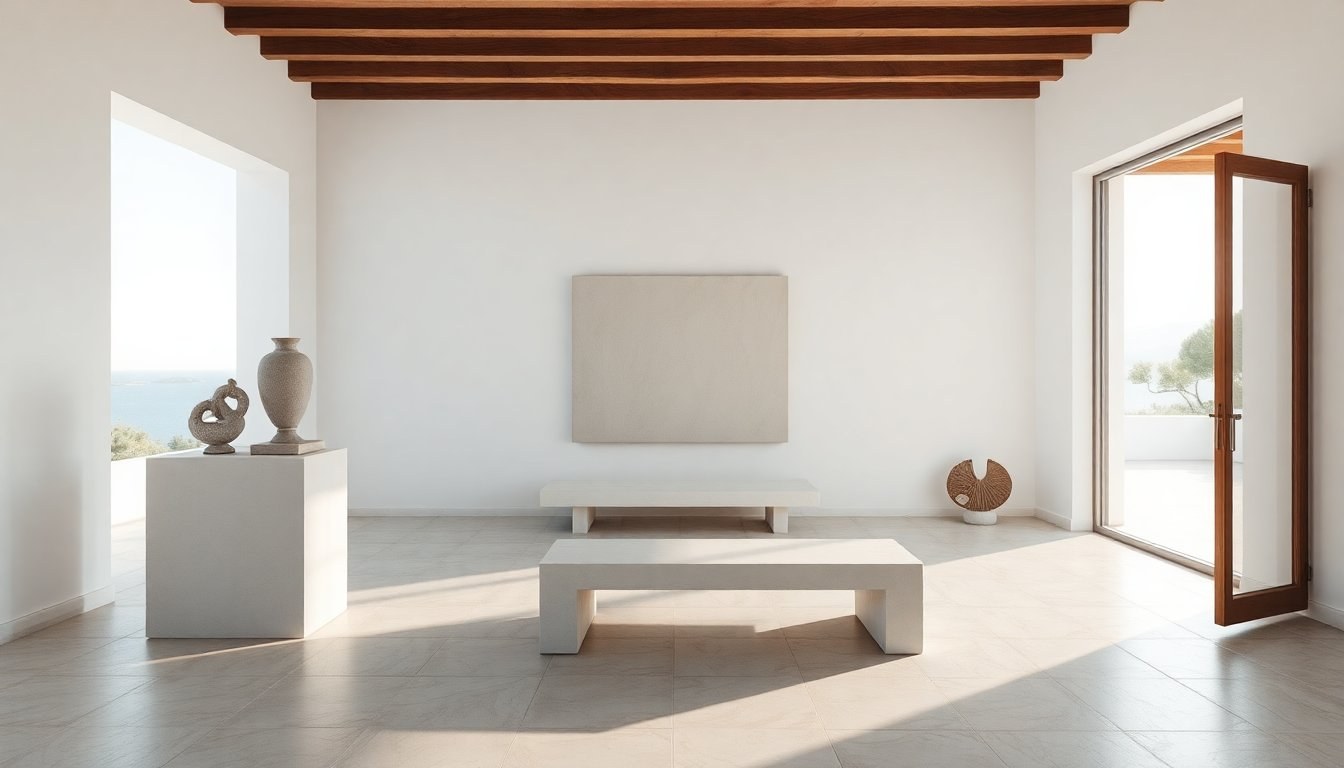
The project by Sanayi313 sits on the coast overlooking the Aegean, conceived as a vacation residence for a young family that wanted generous volumes and a place to display a significant art collection. Spread across approximately 600 square meters on three levels, the house privileges continuity between inside and out: full-height glazing frames the sea while terraces and sliding openings let the interior breathe. Rather than a purely minimalist exercise, the scheme treats white as an operative element — an active surface that captures and redistributes daylight, creating backgrounds where artworks and handcrafted pieces can emerge without visual competition.
Design framework and material palette
The interior language is intentionally restrained: a limited set of materials and carefully chosen furnishings compose the narrative. Continuous floors in Dekton in a stone tone provide a unified base, while varied textiles and tactile surfaces introduce warmth and contrast. Handcrafted elements — low tables clad in handmade ceramics and cushions made from vintage kilim — add textured counterpoints to sleek finishes. Signature pieces such as the Tender Pray bench by James Plumb and the Daphine floor lamp by Lumina act as focal notes within a calm field, enabling objects and artworks to assert themselves without disturbing the overall harmony.
White as a spatial instrument
The architects articulate the use of white beyond mere color: it is a device that responds to changing light and frames the collection. Because of this approach, the interiors can absorb new acquisitions and heterogeneous objects — contemporary artworks sit comfortably alongside vintage furniture and artisanal crafts. Mirrors are placed strategically to reflect both light and views, amplifying sightlines toward the sea and multiplying perspectives. The layout alternates intimate rooms and double-height volumes, so the experience of scale shifts as one moves through the house and daylight sculpts each moment differently.
The art-first strategy
From the entry, the collection establishes the tone: a black-and-white photograph by Araki Nobuyoshi greets visitors with immediate visual authority. Works by artists such as Erol Akyavaş and Mustafa Hulusi are integrated into the route without hierarchy; the design team assembled a backdrop so that conversations between pieces — rather than singular masterpieces — define the residence. The result is an intimate gallery where everyday routines and cultural objects coexist, and where the architecture steps back to let art and people interact.
Indoor-outdoor dialogue and vertical circulation
Large sliding glass walls turn the terrace into an extension of the living room, with consistent materials and furniture — jute rugs, Giro sofas by Kettal and outdoor armchairs — promoting a seamless transition. When open, the openings can nearly double the usable living area, so the family inhabits a fluid boundary between sheltered interior and coastal exterior. Light orientation was considered to capture morning sun and evening cool, allowing occupants to follow natural rhythms. Inside, mirrors and layered lighting balance bright exposures with softer, shaded corners.
The staircase as connective sculpture
The internal stair functions as both a pragmatic connector and a visual anchor: placed within a pared-back shaft, it reads like a quiet sculpture linking the three floors. A rhythm of wall-mounted appliques and select sculptural objects punctuate the ascent, turning vertical movement into a sequence of framed views. This careful choreography reinforces the dialogue among materials, objects and viewpoints, helping the house maintain equilibrium between restrained minimalism and textured, lived-in accents.
Overall, the Bodrum vacation home demonstrates how architecture, interiors and a private collection can coexist on equal footing. By making light and white surfaces the principal tools, the design creates a flexible canvas: one that adapts with the hours of the day, accommodates diverse objects and lets everyday life unfold against a quiet, thoughtfully layered backdrop.


