

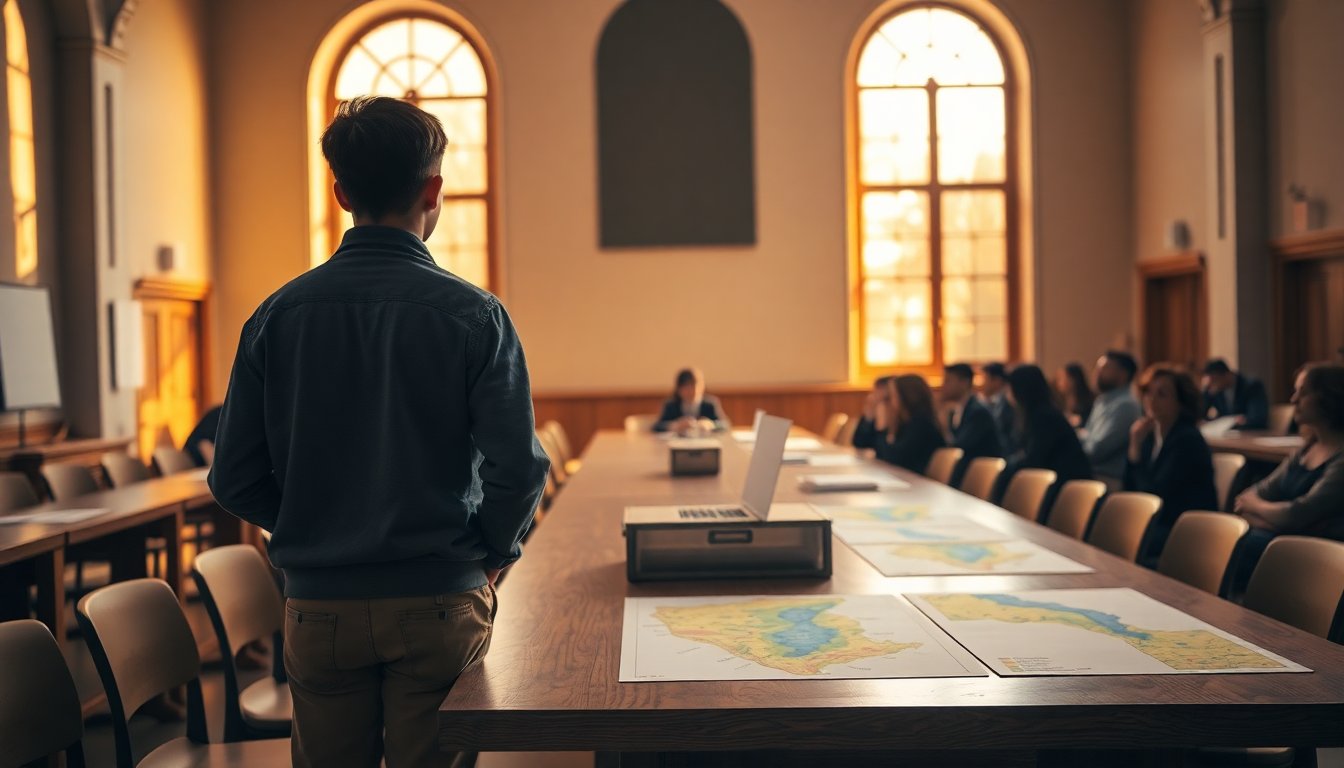
The second plenary session of the youth council brought together student delegates and municipal officials in a formal exchange that summarized three years of school-based civic work. The assembly included 18 elected young councillors from 17 classes across nine school sites and was supported by the Fondazione RagazzinGioco. In this meeting the students translated classroom activities into items intended for institutional attention: a mix of visual maps generated with artificial intelligence, symbolic capsules of time and clear operational requests. The initiative preserved the educational purpose of the project while offering the administration a compact, youth‑driven agenda to consider.
The plenary meeting and participants
The session took place in the municipal council chamber and featured the voices of the young spokespeople alongside elected administrators. Present were deputy mayor Mara Piccin and the assessors Guglielmina Cucci, Lidia Diomede, Mattia Tirelli and Pietro Tropeano, who listened as the students reported their classroom work and plenary outputs. Leadership in the assembly was assumed by the mayoral spokesperson Sofia Bergamin and deputy spokesperson Elia Battiston, who guided a structured handover of proposals produced during the 2026 cycle. This encounter was conceived as both a formal restitution and a civic lesson: young people practiced public presentation and the administration received a distilled set of priorities created by their peers.
Themes and symbolic tools
Work in the schools was organized around thematic pillars that surfaced throughout the plenary: interculturality, heritage and landscape, school and digital accessibility, and participation and community networks. To make abstract ideas tangible, educators introduced interactive simulations and the symbolic device of capsules of time—small collections meant to communicate what to conserve, change or hand down. Students also produced posters and maps using digital aids; these artifacts condensed group discussions into visual priorities that could be scanned by decision‑makers. The combination of symbol and tech aimed to create both emotional resonance and practical guidance.
Interculturality and heritage
On intercultural topics the young delegates emphasized welcoming strategies and opportunities for meaningful encounters, proposing the reuse of abandoned buildings as social resources. Regarding patrimony and landscape, pupils urged attention to historic sites and neighborhood gathering points, arguing that caring for visible heritage fosters civic belonging. Several groups mentioned specific local landmarks as places that could gain new life through carefully planned regeneration, all while looking ahead to the profile boost represented by Pordenone Capitale della Cultura 2027. The call was for revitalization that balances preservation with contemporary community uses.
Digital access and community participation
When addressing school life and technology, the students framed digital tools as essential for modern learning but stressed the need for balance: more access, clearer rules and an emphasis on well‑being. Proposals included using devices for collaborative projects and presentations while protecting offline time. In the discussion on networks and community, the message was practical—young people asked for dedicated times and flexible spaces to meet, and for adults to practice active listening so participation becomes routine rather than occasional. The group cited existing youth labs and centers as models that could be expanded.
From classroom ideas to municipal proposals
Specific operational suggestions emerged from the plenary: flexible youth hubs with extended opening hours, targeted recovery of neglected structures for social and housing functions, and curricular experiences that explain how local institutions work. The students also proposed experimenting with school‑based digital projects that mirror civic collaboration. All these ideas were packaged as a coherent set of priorities and delivered to the municipal team with the explicit hope that they become parts of policy decisions. The presentation format—maps, posters and time capsules—intends to keep proposals visible and memorable for future administrations.
Continuity, impact and next steps
The CCR project, promoted by the municipality in partnership with Fondazione RagazzinGioco and local schools, involved hundreds of pupils over three years and engaged roughly 250 students in 2026 from the Rorai Cappuccini, Centro, Sud, Torre complexes and the Don Bosco middle school. Organizers describe the cycle as an educational pipeline that teaches civic practice and creates a legacy for subsequent cohorts. Participants hope the work will not be a one‑off: the aim is to embed youth participation in regular planning, using symbolic artifacts like the capsules of time and functional tools like AI‑generated maps to co‑design urban regeneration and everyday community life.


