

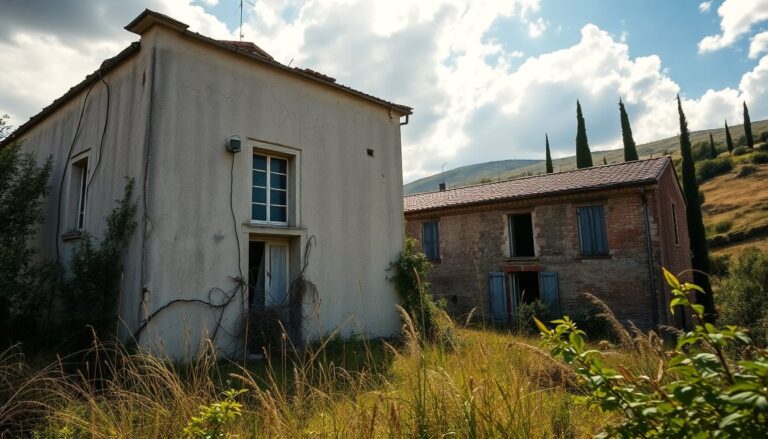
Italy is home to numerous abandoned buildings, many of which are classified as dilapidated structures. These properties often suffer from significant neglect and lack economic value or income potential. Understanding the complex legal framework surrounding these buildings is essential for current owners and prospective buyers.
It is crucial
to differentiate between a dilapidated building and one that is merely uninhabitable. While uninhabitable properties may have restrictions on usage, dilapidated structures are defined as being in such disrepair that they cannot be utilized in any way.
The facts
Dilapidated structures exhibit visible signs of decay. These buildings have, for various reasons, lost their integrity and safety. Their condition is the primary criterion for classification, irrespective of historical significance, construction era,
or materials used.
Characteristics of dilapidated buildings
It is vital to emphasize the distinction between dilapidated buildings and stable ones. The latter maintains its structural integrity and safety, while dilapidated properties can pose serious risks, including potential collapses and low mechanical resistance.
Legalities and registration procedures
According to official sources, the Ministerial Decree n. 28 of 1998 mandates that dilapidated buildings be recorded in the land registry, yet they receive
no income designation. These properties are categorized as F/2, indicating their inability to generate revenue due to their deteriorated state.
Steps for registration
To register a dilapidated building, a specific administrative process must be followed. If a previously registered building has fallen into disrepair, the prior registration must be suspended, and a new registration must be initiated, accompanied by detailed documentation.
Restoration and stabilization efforts
Dilapidated buildings can be targets for restoration initiatives aimed at restoring their stability and functionality. Such efforts may involve structural reinforcement, damage repairs, and compliance with safety regulations.
Safety regulations and compliance
All restoration activities must adhere to current regulations, ensuring the safety of both the structures and their inhabitants. This includes requirements for stability, seismic safety, and energy efficiency. Adhering to the Technical Standards for Construction is paramount to ensure that all renovations meet safety and habitability criteria.
Tax benefits for property owners
From a fiscal perspective, owners of dilapidated buildings may qualify for exemptions from taxes such as the IMU and TASI. However, it is crucial to note that these buildings are ineligible for first-home incentives, as they are not ready for immediate occupancy.
Deductions and incentives
Understanding the differences between dilapidated and uninhabitable buildings is essential, as the two categories are not interchangeable. Uninhabitable buildings might have usage restrictions, whereas dilapidated structures are, by definition, buildings that cannot be used at all.
It is crucial to differentiate between a dilapidated building and one that is merely uninhabitable. While uninhabitable properties may have restrictions on usage, dilapidated structures are defined as being in such disrepair that they cannot be utilized in any way.0