

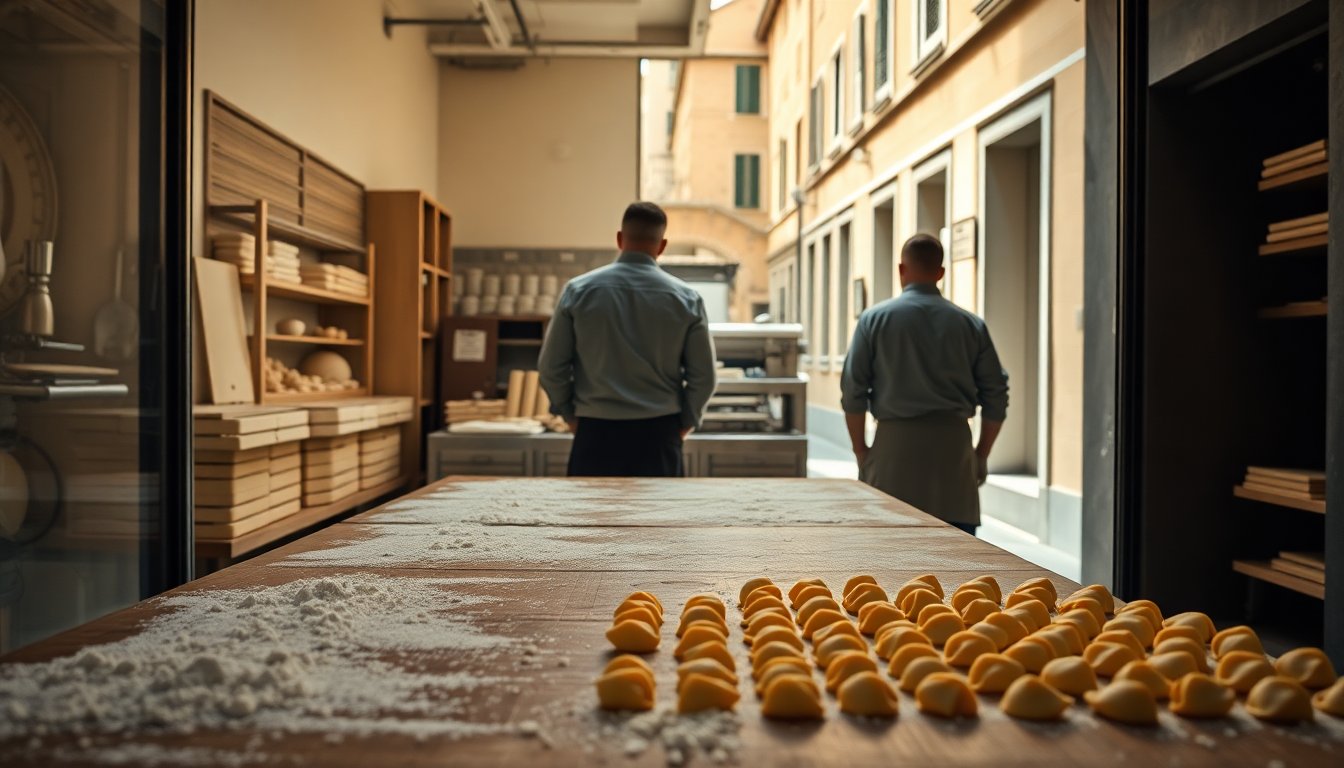
Behind a wide glass frontage in central Bologna, hands press dough, sheets are rolled, and tortellini are folded with care. This is the visible face of Bronzo Pastificio Sociale, an initiative led by Davide Romano that positions traditional pasta making at the center of a pragmatic social project. The workshop is designed first and foremost to produce high-quality food for restaurants and customers, but it also deliberately integrates a learning pathway in which work is the instrument of education. The emphasis on production quality is not decorative: it creates credibility in the market that sustains the social mission.
Romano’s own path informs the concept. Originally from Puglia and trained in Classical Literature at university, he later entered professional kitchens and trained with chefs including Max Poggi. Those experiences shaped his conviction that disciplined culinary work—especially the repeated, skilled gestures required for pasta—can become a vehicle for personal renewal. The enterprise reframes culinary labor as both an economic activity and a teaching environment where routine, timing and teamwork are learned through practice.
The workshop as a public, transparent production space
The laboratory on Via Grimaldi, a short walk from PalaDozza, was intentionally planned as an open studio: a sales counter, work tables and the production line are all visible to passersby and customers. This layout functions as a form of radical transparency: the production process is exposed, the effort is obvious and the people involved are seen rather than hidden. Customers are thus invited to value both the product and the social intentions embedded in its making. Transparency strengthens trust with local restaurants and daily buyers, which helps the operation stand on its own commercially.
Training structure and local networks
Behind the counter sits a more complex support system. A stable roundtable made up of public bodies, cooperatives and local associations handles candidate selection and creates individualized pathways. Those who join the program follow a remunerated, structured experience where daily tasks are deliberately designed as learning moments: mastering dough consistency, adhering to hygiene and timing protocols, and developing cooperative habits. The program relies on practical repetition so that technical skills and workplace behaviors are acquired through production rather than classroom-only instruction.
Selection and partnership mechanisms
Selection is collaborative. Local institutions and third-sector partners screen and accompany participants, offering tailored follow-up and monitoring. This networked approach ensures that entry into the workshop is meaningful and that progress is tracked. By integrating external social actors into the day-to-day operation, the workshop avoids becoming an isolated incubator and instead remains embedded in the city’s support ecosystem—an important factor for participants preparing to re-enter the broader labor market.
Paid work as learning
Participants are employed while they learn; this is a deliberate choice. Paid engagement frames the experience as real work, not charity, and reinforces responsibility and dignity. The routine production of fresh pasta—tortellini, tagliatelle and regional staples—becomes an on-the-job training program where interpersonal skills such as punctuality, teamwork and attention to procedure are taught alongside technical craft. The model privileges practice over rhetoric: competence and employability grow from doing.
Extension inside the prison and the idea of transition
The project also operates inside the Casa Circondariale di Bologna, where detainees near the end of their sentences produce bronze-drawn dry pasta. The term bronze-drawn is used here as a description of a specific extrusion method—the pasta is pushed through bronze dies to create a rougher surface that holds sauce better. This prison workshop follows the same philosophy: teach a concrete trade that can act as a bridge to life outside. The model is conceived as an enterprise of transition, meaning it is not intended as a permanent shelter but as a springboard enabling people to move back into the job market with tangible skills.
Practical pragmatism over heroism
Romano frames the initiative without melodrama. He speaks in terms of adjustments, balance and incremental improvements rather than heroic narratives. His argument is straightforward: social impact endures only if the business model is credible. For Bronzo, that means investing daily in quality production—careful doughs, disciplined processes and consistent standards—while keeping social goals integral to the operation. This combination aims to ensure both financial sustainability and meaningful pathways to autonomy for participants.
Today Bronzo Pastificio Sociale remains a project finding its rhythm: a young workshop, a growing team and a community gathering around a familiar craft. The core idea is simple and practical: repeated artisanal gestures, when embedded in a market-oriented production system and supported by local networks, can become the starting point for second chances. The project shows how a food business can be both commercially serious and socially focused, offering a replicable example of how craft and inclusion can coexist on the same production line.


