

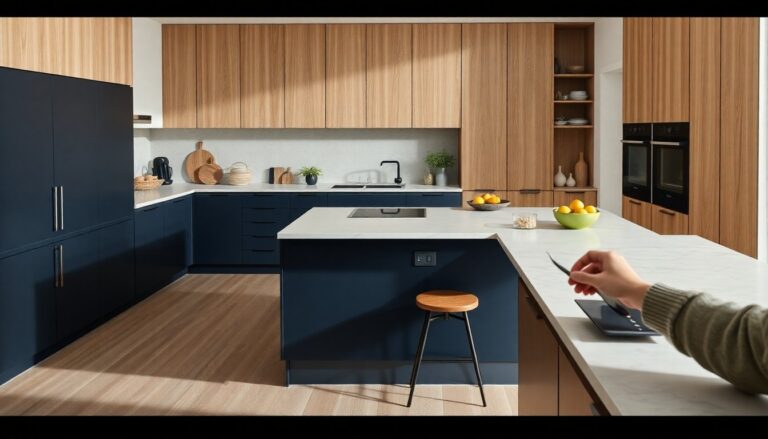
Designing a kitchen that feels modern and livable means making deliberate choices about layout, materials and visual rhythm. A kitchen peninsula—an extension of the main cabinet run that juts into the room—can act as both a workspace and a social hub. The peninsula serves as a physical divider
in open-plan homes while keeping sightlines connected, and it works well as a breakfast counter, prep area or casual dining spot. When planning, consider how the peninsula interacts with circulation, seating and appliance placement so that the space remains inviting and efficient.
Practical planning and dimensions
Start with proportions that respect both ergonomics and aesthetic balance. A well-dimensioned layout maintains a comfortable workflow and a cohesive look:
aim for adequate clearance around the peninsula so movement is unobstructed and seating feels natural. For reference, a model like the Scavolini Evolution features a 4 cm thick laminate top in Rovere Land Scav and a peninsula depth of 120 cm, giving a substantial work surface and room for a breakfast bar. The composition measures include a column wall of 273 cm (height 246 cm) and a sink run of 329 cm, while the peninsula itself spans 255 cm; these
numbers illustrate how a generous peninsula can anchor an open-plan kitchen without crowding the living area.
Work triangle and operational efficiency
Keep functional zones compact but not cramped: the sink, hob and refrigerator should form an efficient path that minimizes steps during cooking. In a peninsula layout you can incorporate the hob or sink on the peninsula itself or leave those fixed on the main run, depending on ventilation and plumbing constraints. The work triangle idea remains useful as a guiding principle; pair it with seating that doesn’t interrupt primary workflows. When appliances are integrated—such as the Electrolux oven/microwave combo, Bosch fridge, Hoover hob and a hideaway Grundig dishwasher listed with some outlet kitchens—verify unit widths (typically 60 cm) and door swings to preserve clearances.
Styling with bicolor schemes and complementary materials
Using two tones can add depth and character without overwhelming the room. A simple rule: consider darker finishes for base units and lighter tones for upper cabinets to keep the composition grounded and bright. The bicolor approach also allows the peninsula to become a focal point—choose a contrasting finish or a natural wood tone to distinguish it from the main run. Material pairings such as laccato opaco with warm wood, or textured surfacing like fenix alongside a smooth gres top, create contrast that reads as intentional and sophisticated. Natural light should guide your choices: smaller or darker spaces call for lighter predominance, while larger open-plan kitchens tolerate bolder contrasts.
Case study: an outlet Scavolini Evolution example
The Scavolini Evolution with central peninsula and breakfast counter offers a practical illustration of the concepts above. Originally priced at €22,300.00, the unit is listed at €10,900.00—an advertised saving of 51%—and is presented as an expo item removed from its packaging and ready for immediate shipment. The composition includes a 4 cm laminate oak-effect top (Rovere Land Scav) and a matte lacquer finish on the cabinets. Included appliances and fittings are: an Electrolux 60 cm oven with microwave in stainless steel, a Bosch 60 cm combined refrigerator, an Apell double-bowl sink with glass drain covers, stainless steel mixer tap, a 90 cm Falmec island hood with chandelier effect, a 60 cm Hoover hob in black and a fully integrated 60 cm Grundig dishwasher. The package also lists a Boiserie Line System Evo. Shipping, transport and assembly are excluded, and measurements are provided so buyers can check site compatibility before purchase.
Buying considerations and installation notes
Outlet or demo units can be a smart way to obtain a high-quality kitchen at reduced cost, but they require extra checks: confirm exact dimensions, note that transport and installation are often not included, and inspect finishes for wear common to display models. Verify that listed appliances—brands such as Electrolux, Bosch, Hoover and Grundig—fit utility hookups and ventilation plans, and ask about warranty coverage for expo items. Finally, plan the final touches: a contrasting peninsula finish, lighting over the breakfast bar and coordinated hardware will help integrate an outlet kitchen into a contemporary living scheme with both comfort and style.
Balancing beauty, comfort and utility is what makes a contemporary kitchen with a peninsula successful. Thoughtful proportions, considered bicolor kitchens strategies, and careful selection of materials and appliances allow the kitchen to be a seamless, social center of the home. Whether designing from scratch or selecting a ready-made model like the Scavolini Evolution, prioritize clear measurements, functional zoning and finishes that reflect how you live to achieve a space that performs as well as it looks.