

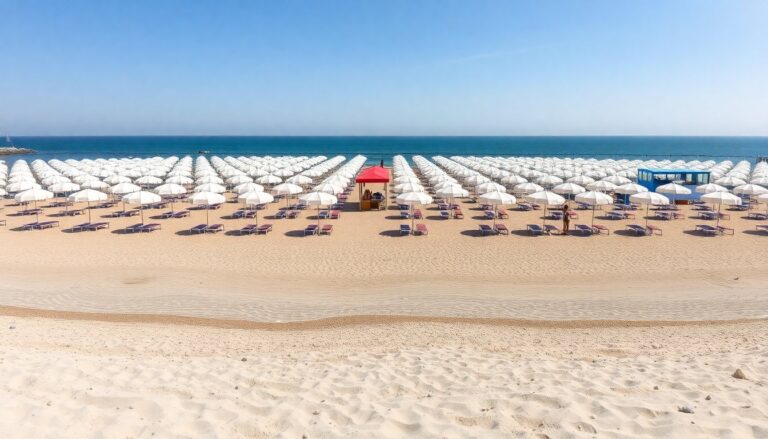
The summer landscape along Jesolo’s shore has been altered by administrative decisions and regional regulations that together changed how beach space is allocated. Residents reported that the sector labeled Umg 5, the strip between Piazza Brescia and Piazza Mazzini, moved to a new operator after
the municipality ran tenders under the provisions of Law 33. The company awarded the concession, CBC srl, deployed roughly 2,000 umbrellas in that stretch, a substantially smaller tally compared with prior seasons. Those numbers reflect not only the concessionaire’s choices but also updated regional technical rules that require wider spacing between stakes.
Second-home owners who traditionally relied on assigned beach spots found themselves competing
with professional accommodation providers. Residents say that about 85% of the available umbrellas were allocated to hotels, leaving only a fraction for private apartments—many of which had previously enjoyed a one-umbrella-per-unit expectation. The change is amplified by the concessionaires’ adoption of a dynamic model, which links occupancy to actual demand and circulates beach equipment back into availability when subscriptions lapse, for example via the new fortnight subscriptions. The
result has been crowded shores, frustrated families and growing concern about potential impacts on property values.
How allocation rules changed the beach
The combination of tender criteria and the regional regulatory framework reshaped resource distribution along Umg 5. Under the new tender outcomes, priority was given to commercial accommodation operators, while apartments rented through agencies—often on short-term platforms—received the remaining positions. The regional mandate to increase distances between umbrella posts has a direct effect on capacity: fewer physical footprints can be installed per linear metre of shoreline. This technical adjustment—presented by officials as a safety and comfort measure—has practical ramifications for everyday access, especially on peak days when a single influx can leave a thousand or more people without their customary spot.
Allocation mechanics and the dynamic approach
The concessionaire’s dynamic management introduces rotation and temporality into what was previously a static allocation system. Under this scheme, beach equipment is managed like a short-term inventory: patrons may buy or renew blocks of use, such as the quindicinal subscriptions, and unused slots return to the market after the subscription window closes. Proponents argue this maximizes utilization and reduces wasted space. Critics counter that it privileges commercial turnover and short-stay tourists over stable second-home residents who expect fixed rights to adjacent shoreline amenities.
Practical consequences for owners and the market
The immediate fallout has been logistical frustration for families arriving for a day at the beach and discovering their usual placements occupied. Early estimates from various reports suggest at least a thousand visitors were disadvantaged on a single heavy-traffic day following the school year’s end. Beyond inconvenience, owners voice economic anxieties: some believe restricted beach access could depress the attractiveness and, consequently, the market price of summer apartments. Anecdotal claims have floated potential reductions in value that in isolated cases approach 20%, though any broader valuation impact would require formal appraisal and market analysis.
Organizing pushback and legal options
Local homeowners are organizing to defend their interests. Discussions have revolved around forming a committee to negotiate with authorities and evaluating collective legal strategies, including the possibility of a class action against the concessionaire. An administrative appeal has already been filed and a request for suspension is pending before the TAR, which could slow or alter the operational roll-out if the court grants interim relief. Meanwhile, some residents have staged informal measures—reserving spots early or sitting on equipment in hopes of avoiding removal—while others plan demonstrations to demand minimum guaranteed access.
Related coastal initiatives and municipal services
Parallel to the concession debate, other coastal policies are progressing. Representatives of local beach kiosks, under the association Veneto Chioschi, commissioned a study that follows the municipality’s variant to the shoreline plan. The proposals would allow chioschi to be restored and expanded up to 42 square metres—up from the prior 30-square-metre cap—and could introduce new shapes and rooftop terraces. Stakeholders ask for differentiated planning by zone and have urged a dialogue with the Comune to balance larger facilities with safety and aesthetic considerations, also flagging recent thefts and requesting stronger security measures.
At the municipal service level, Jesolo’s administration is also managing a separate but time-sensitive campaign: the replacement of paper identity cards ahead of the EU-mandated cessation of their validity on 4 August 2026. Local records show about 2,655 residents still hold paper documents, alongside roughly 700 Cie (electronic identity cards) due to expire in the same period—more than 3,300 total renewals to be handled between March and August. The Comune is processing appointments in staggered blocks to avoid pressure on counters. A national simplification measure, decree n. 19 from 19 February 2026, extends a 50-year validity to new Cie issued to people aged 70 and over starting 30 July 2026, a detail that affects planning for older residents.
Outlook
The situation in Jesolo highlights competing priorities: maximizing tourist infrastructure efficiency, respecting updated safety and spacing rules, and preserving access expectations for second-home owners. The coming weeks will test whether legal interventions, local negotiation or operational tweaks by concessionaires and the municipality can rebalance use of public beach space. As chioschi redesigns and administrative renewals proceed in parallel, policymakers will face choices with implications for both everyday visitors and the local property market.