

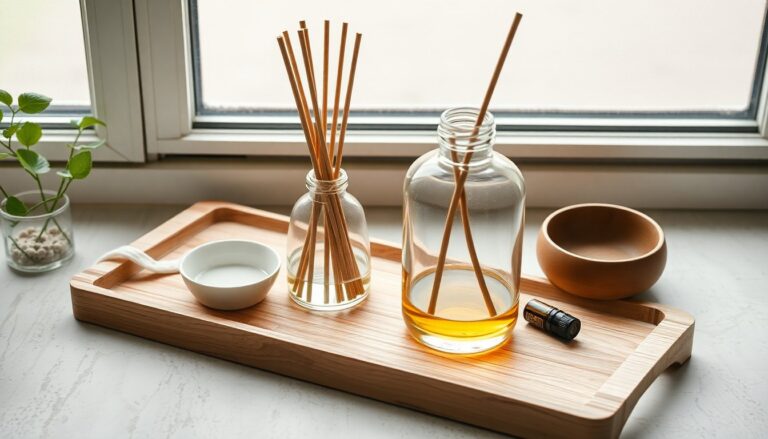
Who this guide is for
– DIY cooks, renters, and parents who want an affordable, low-chemical way to scent small rooms.
– Anyone who prefers to control ingredients and fragrance strength instead of buying ready-made products.
What you’ll make
A simple, natural reed diffuser using everyday
tools. It’s suitable for bedrooms, kitchens, bathrooms and small living spaces, and it’s easy to scale by bottle size and ventilation.
Before you start — a quick overview
A reed diffuser needs three things: a carrier (the liquid that transports the scent), essential oils (the fragrance), and reeds (the wicks). Different carriers change how fast the scent evaporates and how long the diffuser lasts. Read the
safety notes below before handling alcohol or concentrated oils, and keep materials out of reach of children and pets.
Supplies
– A small glass bottle or jar with a narrow neck (reduces evaporation and spillage). – Rattan reeds or bamboo sticks (6–10, depending on vessel size). – A carrier solvent: either perfumer’s alcohol or a cosmetic-grade carrier like dipropylene glycol (DPG). Avoid using undiluted rubbing alcohol near open flames. – Distilled or filtered water (optional;
see notes on use below). – Essential oils (choose high-quality, pure oils). – Optional: funnel, pipette, measuring jug, labels.
How the components work
– Carrier solvent: dissolves the essential oils and allows them to travel up the reeds. Perfumer’s alcohol and cosmetic-grade glycols are common. Alcohol speeds release; glycols release scent more slowly and are less flammable. – Essential oils: provide the scent. Top notes (citrus, herbs) evaporate quickly; middle/base notes (floral, resinous, woody) last longer. Blend accordingly. – Water: can slow evaporation and dilute intensity, but too much can separate the mix or encourage microbial growth. Use sparingly and only with carriers that tolerate dilution.
Practical base ratios (flexible)
Use these as starting points, then tweak for room size and ventilation:
– Carrier (alcohol or DPG): 60–85% of the final volume. – Essential oils: 10–30% of the final volume (start low and increase as needed). – Water: 0–10% (optional; only use distilled water and keep it minimal).
Note: recipes found online vary widely. If you’re using DPG or perfumer’s alcohol, less water is better. If you choose alcohol as the carrier, keep flammability in mind and don’t mix near open flames.
Step-by-step: make your diffuser
1. Work on a stable, protected surface and ventilate the room. Keep flames and heat away from alcohol-based mixes. 2. Measure the carrier into your bottle (use a funnel). Leave headspace for reeds. 3. Add the essential oils directly to the bottle. Swirl gently to blend — don’t shake vigorously. 4. If you’re using a small amount of distilled water, add it now and stir gently. 5. Insert the reeds and let them soak 10–20 minutes, then flip them once to prime. 6. Place the diffuser somewhere stable, out of direct sunlight and away from drafts. Flip the reeds weekly to refresh the scent. Replace reeds every 1–3 months or when they clog.