

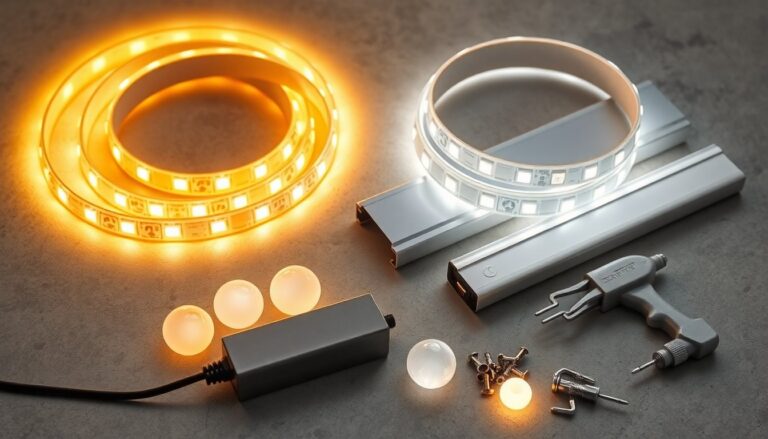
The use of LED strips has become a fast, affordable way to update interior and exterior lighting without a major renovation. In this article you will find practical guidance covering the main product families, essential technical data and the typical use cases that help decide
whether a given strip is best for mood lighting, functional illumination or weather‑resistant outdoor applications. The text mixes hands‑on installation tips with the information to compare options based on lumens, power and protection rating, while defining key concepts so you can make an informed purchase.
Before buying, consider where the strip will be installed and how you want to control it: a simple remote, a wall switch, or a full smart ecosystem. Many
modern kits allow voice commands via Amazon Alexa or Google Assistant and connect over Wi‑Fi, but basic cordless or battery models still have a place for closets and temporary setups. Knowing the difference between decorative RGB effects and stable white light for tasks will guide choices around color temperature and brightness.
Core types and technical specifications
On the market you will find strips sold in standard
reels—commonly 1 m, 2 m, 3 m or 5 m—plus modular pieces you can join or shorten. Key metrics to compare are watts per meter, total lumen output and the LED density often expressed as the number of LEDs per metre (for example 60, 90 or 150 LEDs). Many product listings show overall lumen figures for a kit (for example 1080 lm or 3000 lm) and whether the strip supports RGB color mixing or fixed white light with selectable color temperatures like 3000 K or 4000 K.
Lengths, power and brightness
Power consumption ranges widely: ultra‑portable battery strips can draw as little as 2 W, while high‑output kits for shelves or task lighting may reach 30 W or more across a longer run. Look for lumen numbers to understand perceived brightness, and check whether the supplier lists lumens per metre when comparing different reels. Remember that cutting a strip at designated points is common, but each cut reduces the remaining circuit length and may require additional connectors or a new power supply.
LED count and color control
Strips intended for dynamic color scenes usually advertise RGB or RGBW capability and list LED counts (for example 90 or 150 LEDs per reel). Control can be via a basic IR or RF remote, a wired controller, or through apps when the strip is smart. When you need precise effects or addressable segments, look for individually controllable LEDs; for simple ambiance, ordinary RGB strips and a remote are sufficient. Always verify if extra extension reels are supported by the brand.
Outdoor protection, materials and neat installation
For any installation exposed to moisture choose strips with an appropriate ingress protection rating: an IP44 rating or a silicone sleeve can resist splashes and humidity, while indoor units are often rated IP20. Using aluminium profiles not only sharpens the look but also improves heat dissipation, which extends life and helps maintain light output. Adhesive backing makes fitting fast, but metal clips and aluminum channels offer a cleaner finish and better mechanical stability in visible areas.
Practical mounting tips
Connectors and cutting points
Plan the route before sticking down the strip: mark cut points and test connectors on a bench to avoid surprises. Many strips include cut lines where the circuit can be safely separated; use the proper connectors to rejoin segments, and choose an appropriately rated transformer or driver that matches the strip’s voltage and power needs. For battery units with motion sensors, the benefits are easy installation and on‑demand activation, though autonomy may be limited.
Smart control, use cases and buying advice
Smart systems add convenience: app control and scheduling let you create scenes for cinema nights, cooking, or relaxed evenings, while compatibility with Amazon Alexa and Google Assistant enables voice commands. If you plan to integrate strips into an existing home network, check that the product supports your chosen platform and whether a hub is required. For those who want plug‑and‑play simplicity, complete kits that include the power supply, remote and connectors often save installation time.
Finally, match the product to the purpose: choose RGB or multicolor strips for decorative accents, and fixed white strips with a defined color temperature for task lighting. Consider cable lengths, the availability of extension connectors, and the manufacturer’s stated lifetime and warranty. With careful selection—balancing brightness, protection and control—you can achieve dramatic results that are economical, easy to install and durable.